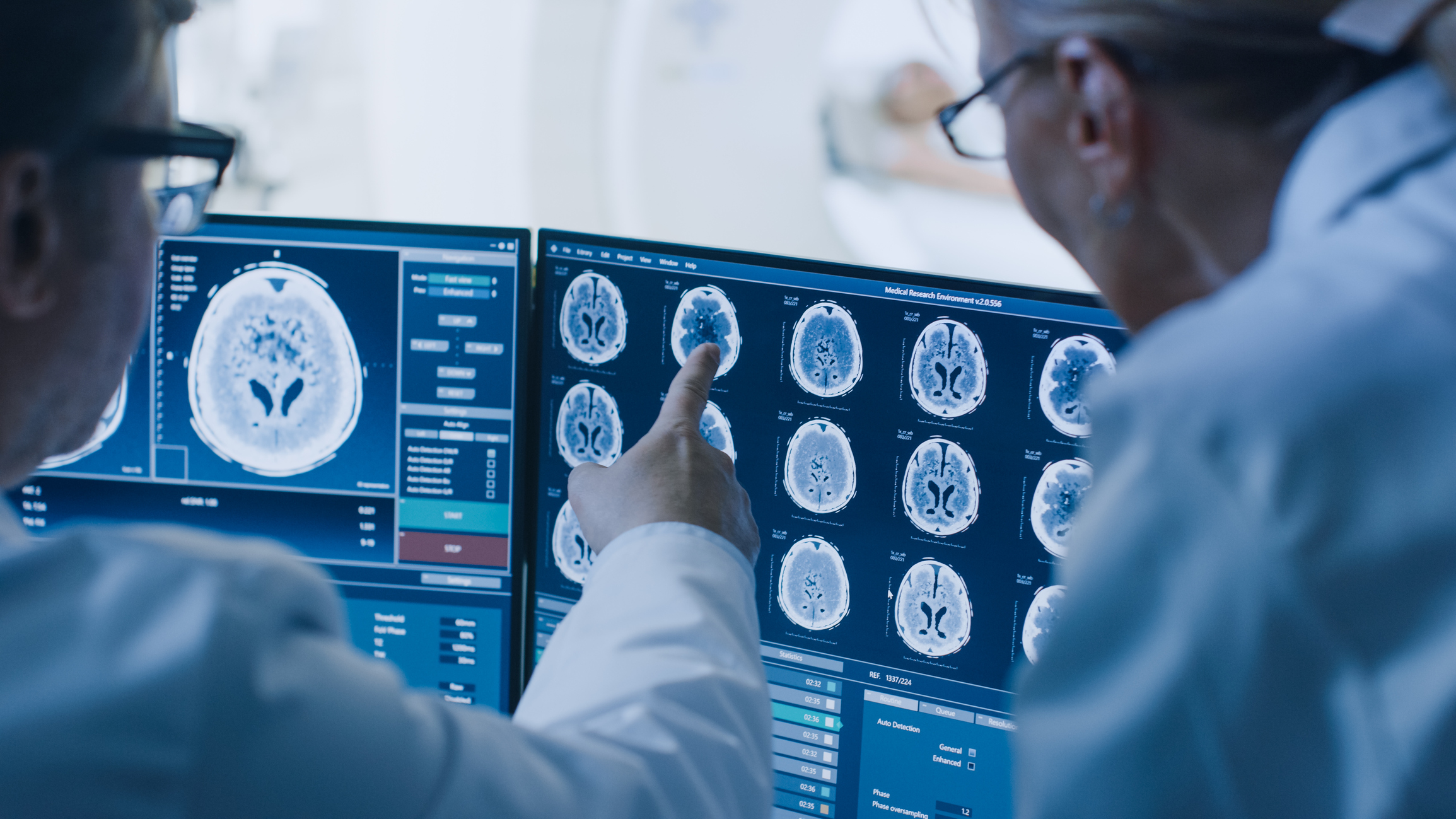
Full DICOM-native VNA (Vendor Neutral Archive), zero-footprint web viewer, AI-assisted reading triage, and native integration with HMS RIS and EMR. Supports every modality — CT, MRI, CR, DR, US, NM, XA, PET, Echo, Mammography.
Six measurable improvements that radiologists, technologists and IT administrators notice within the first week of go-live.
DICOM archiving eliminates film costs permanently — no more physical storage cabinets, no courier services, no light-boxes. Every study is stored losslessly and retrievable in seconds from any authorised workstation.
Browser-based HTML5 viewer — no installation, no plug-in, no IT ticket. Works on tablets for ward rounds, on large diagnostic displays in the reading room, and on remote workstations for teleradiology. One click to open any study.
Any study from any facility in the network is instantly visible to any authorised clinician — without a study transfer step, without a CD burned at the front desk, and without waiting for a courier. Unified patient imaging history across every site.
Triage algorithms surface urgent findings — pneumothorax, PE, intracranial haemorrhage — to the top of the worklist automatically. Pre-populated structured report templates in RIS mean radiologists focus on interpretation, not data entry.
HSM moves aged studies from high-performance SSD to near-line NAS to deep cloud archive automatically, based on age and access frequency — with no manual administration. Storage costs drop over time while retrieval performance stays high for recent studies.
Tamper-evident audit logs capture every study view, download and share. Configurable retention schedules enforce national data-retention rules automatically. JCI and CBAHI survey documentation is generated from the audit trail — no manual preparation.
Eight core capability areas that together make metaPACS a complete, production-ready imaging platform — not a collection of loosely connected tools.
Full DICOM 3.0 SCP/SCU: C-STORE, C-FIND, C-MOVE, C-ECHO. Supports CT, MRI, CR, DR, US, NM, XA, PET/CT, Echo, Mammography, and Secondary Capture. WADO-RS and WADO-URI for DICOMweb clients. Multi-site federation — studies from any facility visible in a unified timeline without migration. Automatic deduplication and integrity verification on every ingest.
HTML5 and WebGL rendering — no plug-in, no installation. Multi-planar reconstruction (MPR), maximum intensity projection (MIP), hanging protocols per modality, window/level presets, cine mode, annotation tools, measurement tools and key image notes. Accessible from any modern browser on desktop, tablet and large diagnostic displays. Radiologist and clinician views have separate default layouts and hanging protocols.
DICOM MWL SCP broadcasts scheduled procedures to modalities — eliminating manual demographic entry at the scanner. Integrates directly with RIS scheduling so the technologist worklist is always in sync with the appointment book. Reduces patient identification errors and saves 3–5 minutes per study at the acquisition stage.
ML triage layer flags urgent findings — pneumothorax, pulmonary embolism, intracranial haemorrhage, critical chest findings — and surfaces them to the top of the reading worklist. AI findings are overlaid as annotations in the viewer and can pre-populate a structured report template in RIS. Radiologist validates and signs: no AI decision is final without radiologist approval. Vendor-neutral orchestration — connect any approved algorithm.
Native HL7 ORM/ORU and FHIR R4 ImagingStudy resources. Study links appear directly in the EMR patient timeline — one click opens the viewer from the chart. Ordered studies auto-appear in the PACS worklist via RIS. Signed radiology reports return to the EMR without a copy-paste step. No middleware required within the metaSOFT platform.
CD/DVD burning with auto-run DICOM viewer burned alongside the study — patient arrives at a referral centre with a self-contained disc. DICOM email, WADO web links for external referrals, print to DICOM printer. DICOM TLS for secure transmission over untrusted networks. Supports walk-in referral workflows and teleradiology reading centres.
Three-tier storage: primary SSD for recent studies, near-line NAS for aged studies, S3-compatible cloud deep archive for long-term retention. HSM policy-based migration is fully automatic. Full RAID mirroring on primary tier. Remote DR replication with RPO < 1 hour and RTO < 4 hours. Weekly backup verification reports delivered to IT administration.
Role-based study access per job function — radiologist, technologist, referring physician and patient each see the studies and controls appropriate to their role. DICOM TLS 1.2+, AES-256 encryption at rest. Full audit log of every study view, download and share — timestamp, user identity, IP. HIPAA-aligned and Saudi MOH data-retention compliant.
metaPACS stores, routes and displays DICOM studies from every major clinical imaging modality — from standard digital radiography to complex nuclear medicine and hybrid PET/CT. Non-DICOM images can be wrapped and stored alongside native DICOM series in the same study record.
metaPACS is built on open DICOM and HL7 standards and implements key IHE Radiology profiles. This means it connects to any standards-compliant modality, RIS, EMR or national health information exchange without bespoke integration work.
From the moment a physician orders an imaging study to the moment a signed report appears in the patient's record — every step is automated. No manual handoffs, no copy-paste, no re-keying of demographics.
Physician places imaging order in the EMR. Patient identity established in the master patient index.
Order appears in RIS. Radiographer schedules the procedure and assigns an accession number.
DICOM MWL broadcasts the scheduled procedure to the scanner. No manual data entry at the machine.
Completed study is pushed via C-STORE to the VNA. AI triage runs immediately on arrival.
Study link appears in the patient's EMR timeline. Any authorised clinician can open the zero-footprint viewer.
Radiologist reads, dictates and signs the report in RIS. The HL7 ORU message is sent back to HMS automatically.
Study and signed report are filed in the Document & Information System. HSM begins age-based tiering.
That means images acquired at any facility are instantly available to any authorised clinician in the network — without a study transfer step, without a re-login and without a separate patient search. One identity. One session. One archive. metaPACS can also be deployed as a standalone enterprise VNA for organisations already running a third-party HMS — connecting via standard DICOM and HL7 interfaces.
Single MPI shared with HMS, RIS, LIS and EMR — no duplicate patient registration, no mismatch between systems.
Log in once to HMS and open PACS viewer, RIS worklist or LIS results — no separate credentials, no context switch.
RBAC permissions granted in HMS administration flow through to PACS — no separate user database to maintain.
Labs, imaging, notes and prescriptions on one longitudinal timeline — the physician never leaves the EMR to view a scan.